
The Silent Teacher: How Sensory Play Shapes Your Primary Child’s Brain for Mathematics and Logic
Nov 19, 2025
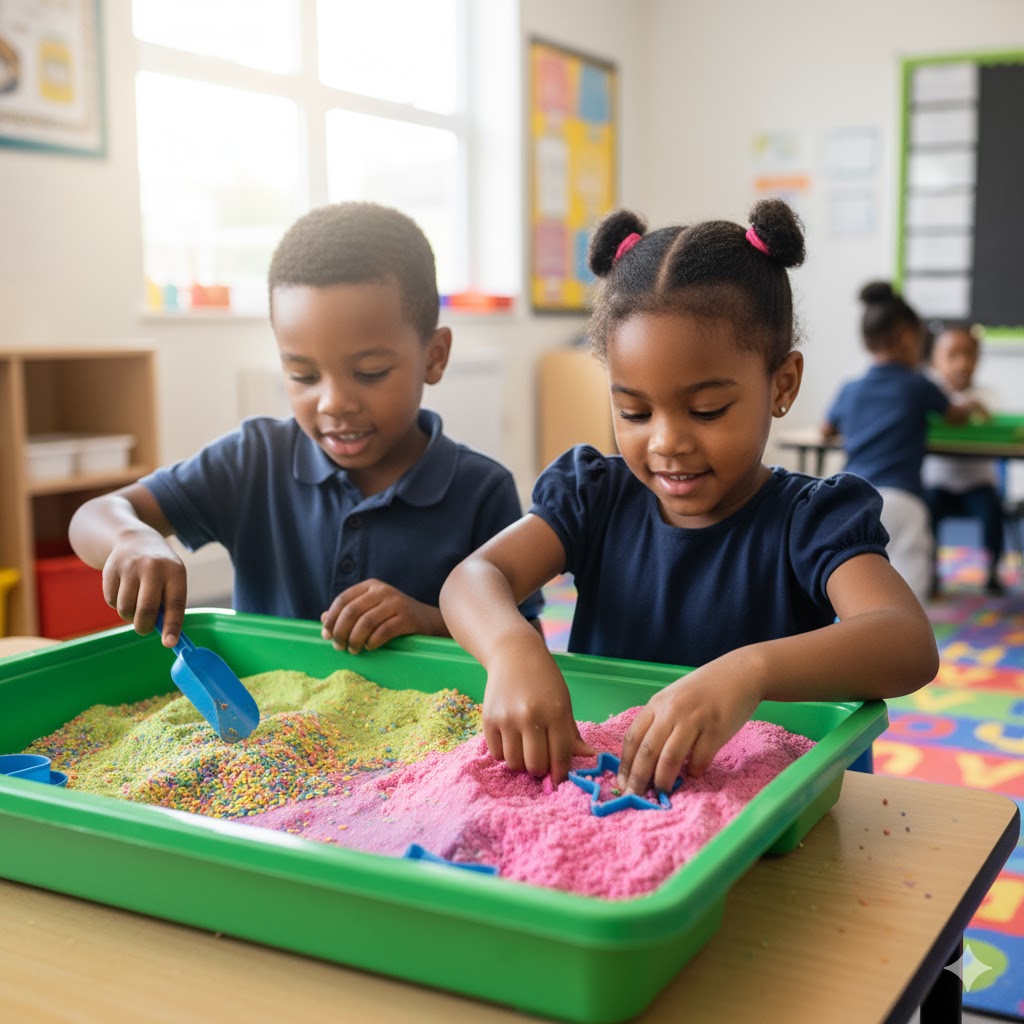
Why Math Starts in the Sandbox, Not the Classroom
When we think of preparing a child for primary school mathematics, we often jump straight to counting, worksheets or memorising multiplication tables. However, true foundational logic – the ability to grasp concepts like volume, quantity, sequence and spatial reasoning – begins much earlier, not with numbers, but with the senses.
Hands‑on, tactile exploration (often called Sensory Play) acts as a “silent teacher”. It builds the neural pathways in the brain that are essential for higher‑order thinking. For children aged roughly 3 to 8, moving from concrete experience (touching a block) to abstract thought (understanding the volume of that block) is the single most important bridge to academic excellence.
The Direct Link: Sensory Input and Cognitive Output
The brain organises information a bit like a filing cabinet. When a child engages in rich sensory play, they are creating physical “files” for size, weight, texture and quantity that later support their maths and science learning.
Spatial Reasoning
When a child tries to fit a large block into a small hole, they are not just learning about sizes. They are mapping 3D space. This mental map is what they will later draw on to understand geometry, charts, diagrams and even coding concepts such as coordinates and grids.
Classification and Sorting
Separating red beans from white beans, or stacking stones by size, is the earliest form of data categorisation. The same skill is needed later for algebra, statistics and data analysis, where learners must group, compare and classify information.
Problem‑Solving
Building a tower that keeps falling teaches more than balance. Each collapse is a mini‑experiment in physics and structural integrity. Children naturally test different strategies, observe outcomes and modify their approach – the foundation of scientific thinking.
Key Insight: The richness of a child’s sensory experience directly correlates with the depth of their capacity for abstract thought later on.
Three High‑Impact Sensory Activities to Boost Logic and Math
These activities require no expensive equipment and can be done easily at home or in a simple classroom setting.
1. The “Volume Swap” (Introducing Conservation and Measurement)
This activity introduces the idea of conservation – understanding that quantity stays the same even if the container changes shape. Many children (and even adults) struggle with this concept in early maths.
Materials: Water, sand or dried rice/beans; two different‑shaped containers (e.g. a short, wide bowl and a tall, narrow bottle).
Activity:
- Fill the wide bowl with water or sand.
- Ask your child to pour the contents into the tall bottle.
- Then ask: “Did the amount change, or is it the same?”
Learning: By repeatedly pouring the same amount into different containers, the child’s brain begins to reconcile the difference between visual perception (height) and actual volume. This prepares them for future work with measurement, capacity and graphs.
2. The “Nature Sequence” (Introducing Patterns and Data)
Pattern recognition is the backbone of mathematics, logic and coding. We can teach complex sequencing using simple natural materials.
Materials: Leaves, stones, twigs or seed pods collected from outside.
Activity:
- Create a simple pattern together, e.g. Leaf – Stone – Leaf – Stone.
- Ask your child to continue the pattern.
- Next, invite them to design a more complex pattern such as Leaf – Leaf – Stone – Twig – Leaf – Leaf – Stone – Twig.
Learning: This trains the brain to predict “what comes next”, which is the heart of algorithms and sequences. The same mental skill is used later in multiplication patterns, number sequences and computer coding.
3. Blind Tactile Sorting (Sharpening Classification Skills)
This game builds on the idea of a “Mystery Box” and forces the brain to rely solely on touch to categorise objects.
Materials: A dark sock or small bag; place random, non‑sharp objects inside (e.g. a coin, a smooth marble, a cotton ball, a piece of sandpaper).
Activity:
- The child puts a hand into the bag without looking.
- They feel each object and try to describe it: smooth, rough, hard, soft, round, flat.
- They then sort the objects into piles such as “smooth things”, “rough things” or “things that roll”.
Learning: The child must build a mental model of each object using only sensory information. This strengthens focus and the abstract skill of creating and applying classification rules – exactly what is needed for grouping numbers, shapes and data later on.
Building Strong Thinkers at King Makers Academy
At King Makers Academy, our curriculum is designed to make learning intuitive, joyful and enduring. We know that logic and mathematics do not begin with textbooks, but with rich experiences in the real world.
By integrating simple sensory activities like these at home and in school, you are doing more than entertaining your child. You are physically building the logical infrastructure they will rely on from Nursery through primary school, up to tertiary education and beyond.
When we honour the power of play in early childhood, we are not delaying “real learning” – we are laying the strongest possible foundation for it.
Categories: Early Development Deep Dive
Tags: ##CognitiveDevelopment, ##EarlyMath, ##LogicSkills, ##NigeriaEducation, ##ParentingTips, ##PreschoolLearning, ##SensoryPlay, ##STEM